


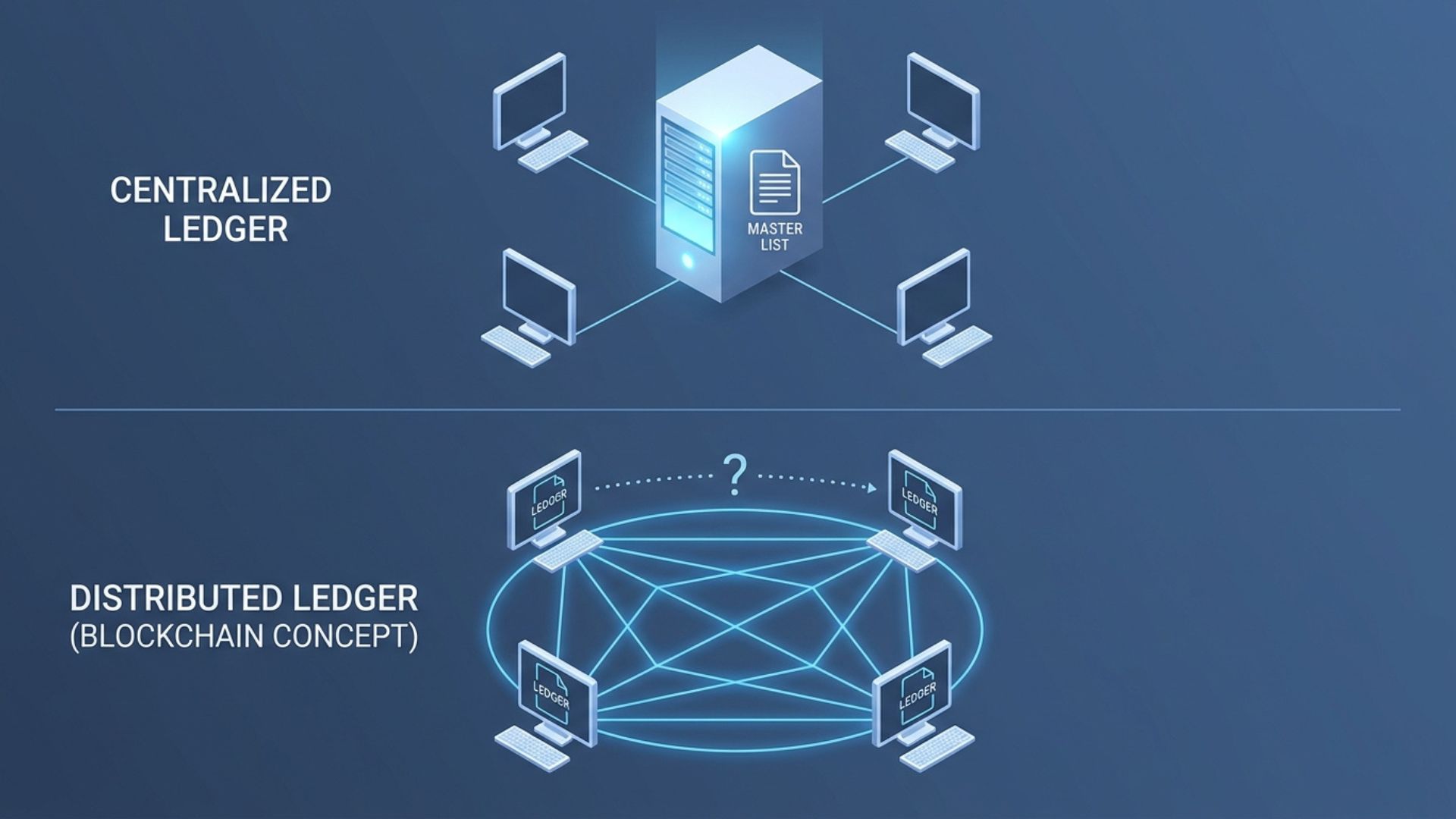
At its core, blockchain is a system designed to store information securely and transparently. Unlike traditional databases controlled by a single organization, blockchain operates on a decentralized network where multiple computers work together to validate and store data. This structure creates trust without requiring a central authority. The result is a technology capable of reducing fraud, improving data integrity, and enabling secure peer-to-peer transactions.
The growing interest in blockchain technology comes from its potential to solve many long-standing problems related to digital trust and data security. Traditional systems often rely on intermediaries such as banks, payment processors, or centralized platforms to verify transactions. Blockchain removes the need for these middlemen by allowing network participants to agree on the validity of transactions through advanced cryptographic mechanisms and consensus algorithms.
What Is Blockchain Technology?
Blockchain is a distributed digital ledger that records transactions across multiple computers in a secure and transparent way. Instead of storing information in one central location, blockchain distributes copies of the ledger across an entire network. Every participant in the network has access to the same transaction history, making the system highly transparent and difficult to manipulate.
The term “blockchain” comes from the structure of the technology itself. Information is stored in groups called blocks, and each block is connected to the previous one using cryptographic techniques. These linked blocks create a continuous chain of records, which forms the blockchain.
One of the defining characteristics of blockchain technology is immutability. Once information is added to the blockchain, changing or deleting it becomes extremely difficult. This is possible because every new block contains a reference to the previous block, creating a secure chain of verified data. Any attempt to alter past records would require changing all subsequent blocks across the network simultaneously, which is practically impossible in large decentralized systems.
Blockchain networks can be public or private. Public blockchains, such as those used by cryptocurrencies, are open to anyone who wants to participate. Private blockchains are controlled by organizations that restrict access to approved users. Both types of blockchains use similar principles but serve different business and operational purposes.
How Blockchain Works Behind the Scenes
To fully understand how blockchain works, it is important to examine the process that occurs whenever a transaction is made on the network. Every blockchain transaction follows a structured sequence involving data verification, consensus mechanisms, and secure storage. When a user initiates a transaction, the request is broadcast to a network of computers known as nodes. These nodes validate the transaction using predefined rules and cryptographic algorithms. The purpose of validation is to ensure the transaction is legitimate and that the sender has the authority or resources required to complete it.
After validation, the transaction is grouped together with other transactions into a block. The network then works to confirm the validity of the block through a consensus mechanism. Consensus ensures that all participants agree on the state of the blockchain before new data is permanently added. Once the block is approved, it is attached to the existing blockchain. The updated ledger is distributed across the network so that every participant has the same version of transaction history. This decentralized synchronization process ensures consistency and transparency throughout the system.
The security of blockchain technology largely depends on cryptographic hashing. Each block contains a unique hash, which acts like a digital fingerprint. Even a tiny change in the block’s data would generate a completely different hash, immediately signaling tampering. This cryptographic structure is one of the main reasons blockchain systems are considered highly secure.
The Role of Decentralization in Blockchain
Decentralization is one of the most important concepts in blockchain technology. Traditional systems rely on centralized authorities such as banks, governments, or corporations to manage and verify information. Blockchain distributes control across a network of participants instead of placing authority in a single organization. In a decentralized blockchain network, no single entity controls the entire system. Decisions are made collectively through consensus mechanisms. This structure reduces the risk of manipulation, censorship, and single points of failure.
Decentralization also improves system reliability. If one computer in the network fails, the blockchain continues operating because other nodes maintain copies of the ledger. This distributed architecture makes blockchain systems more resilient against cyberattacks and technical failures. Another major advantage of decentralization is increased transparency. Since all participants can access the same transaction records, blockchain creates a shared source of truth. This level of openness can reduce disputes, improve accountability, and strengthen trust among users.
However, decentralization also introduces challenges. Decision-making processes can become slower because agreement must be reached across many participants. Public blockchains may also face scalability issues as transaction volumes increase. Despite these challenges, decentralization remains a key reason why blockchain technology has gained global attention.
Blockchain Consensus Mechanisms
Consensus mechanisms are essential to understanding how blockchain works because they allow decentralized networks to agree on transaction validity without relying on a central authority. Different blockchain systems use different consensus methods depending on their goals and operational requirements.
One of the most well-known consensus mechanisms is Proof of Work. In this system, miners compete to solve complex mathematical puzzles in order to validate transactions and create new blocks. The first miner to solve the puzzle earns the right to add the block to the blockchain and receives a reward. This process secures the network but requires significant computing power and energy consumption.
Another popular consensus model is Proof of Stake. Instead of using computational power, validators are selected based on the amount of cryptocurrency they hold and are willing to lock into the network as collateral. Proof of Stake is considered more energy-efficient than Proof of Work because it eliminates the need for resource-intensive mining operations.
Some blockchain networks use hybrid consensus systems or alternative mechanisms such as Delegated Proof of Stake and Practical Byzantine Fault Tolerance. Each approach aims to balance security, decentralization, speed, and scalability in different ways. Consensus mechanisms are critical because they prevent fraudulent activity such as double spending, where the same digital asset is used more than once. By ensuring agreement among network participants, consensus systems maintain trust and integrity within blockchain ecosystems.
Cryptography and Blockchain Security
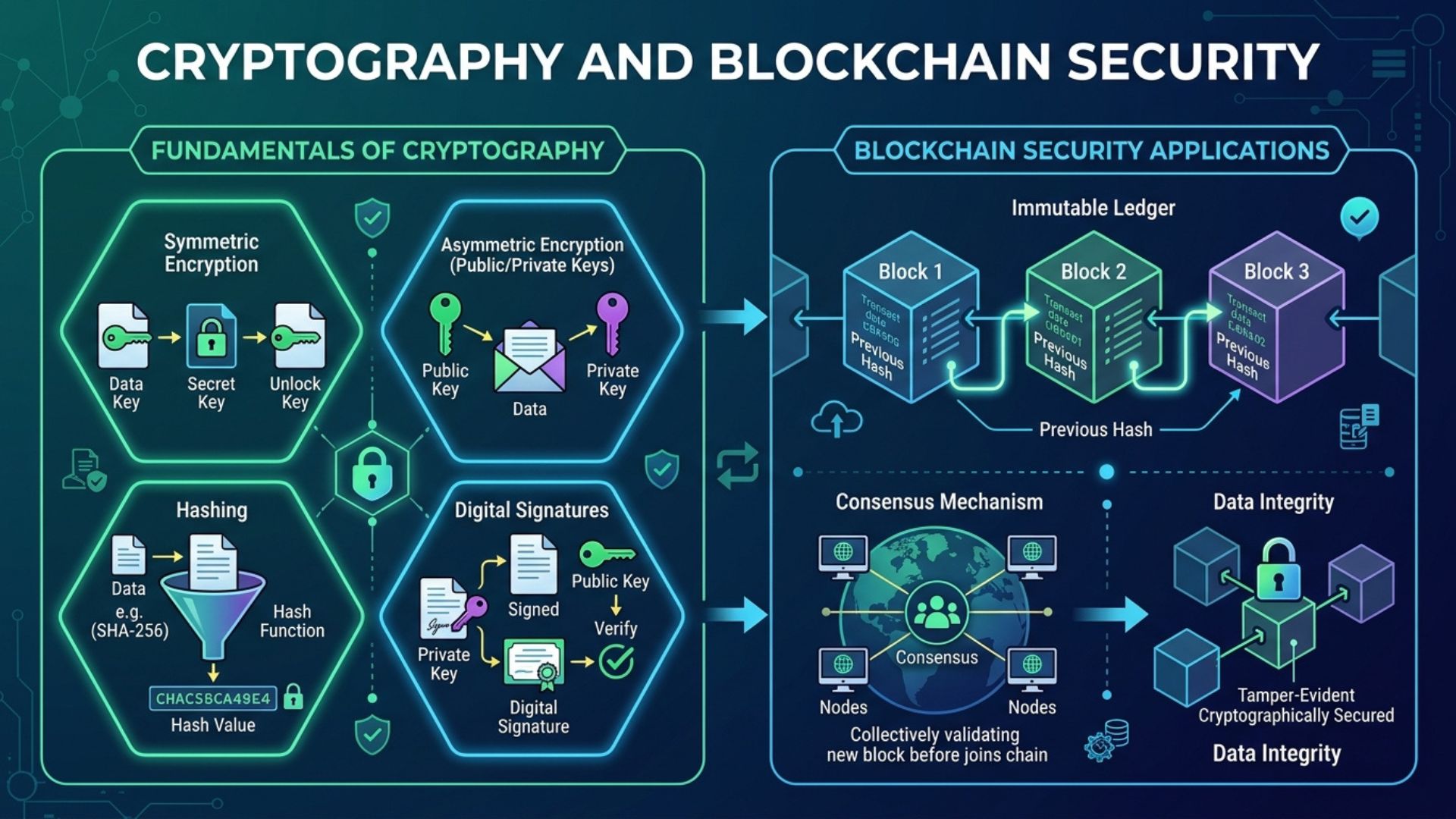
Cryptography is the foundation of blockchain security. Without cryptographic methods, blockchain systems would not be able to protect transactions or maintain data integrity. Blockchain uses public key cryptography to secure transactions. Each user has a pair of cryptographic keys: a public key and a private key. The public key acts like an address that others can see, while the private key functions like a secret password used to authorize transactions.
When a transaction is initiated, it is digitally signed using the sender’s private key. Other participants in the network can verify the signature using the corresponding public key. This process confirms authenticity without revealing sensitive information. Hashing is another critical cryptographic function in blockchain technology. A hash converts data into a fixed-length string of characters. Blockchain systems use hashing to secure block contents and link blocks together. Since hashes are unique, any alteration to the data immediately changes the hash value, exposing tampering attempts.
The combination of decentralization and cryptography makes blockchain networks highly resistant to hacking. To successfully alter transaction records on a large blockchain, an attacker would need to control the majority of the network’s computing power or validation capacity, which is extremely difficult and expensive.
Blockchain and Cryptocurrency
Blockchain became widely known through cryptocurrencies such as Bitcoin and Ethereum. These digital currencies rely on blockchain technology to enable secure peer-to-peer transactions without traditional financial intermediaries. Bitcoin introduced the concept of decentralized digital money by allowing users to transfer value directly to one another over the internet. Every Bitcoin transaction is recorded on a public blockchain, ensuring transparency and preventing double spending.
Ethereum expanded blockchain functionality by introducing smart contracts. Smart contracts are self-executing programs stored on the blockchain that automatically enforce predefined conditions. These contracts enable decentralized applications and complex financial systems without requiring centralized control. Cryptocurrency transactions illustrate how blockchain works in real-world environments. When users send cryptocurrency, the transaction is broadcast to the network, validated by nodes, confirmed through consensus, and permanently recorded on the blockchain ledger.
Real-World Applications of Blockchain Technology
Blockchain technology is being adopted across many industries because of its ability to improve transparency, security, and efficiency. In supply chain management, blockchain helps companies track products from production to delivery. Businesses can verify product origins, monitor shipment status, and reduce fraud by maintaining transparent records on a blockchain network. Healthcare organizations use blockchain to protect patient data and improve interoperability between medical systems. Secure blockchain records can help prevent unauthorized access while allowing healthcare providers to share accurate information efficiently.
Financial institutions are exploring blockchain for cross-border payments and settlement systems. Traditional international transfers can be slow and expensive due to intermediary banks and currency conversion processes. Blockchain-based payment systems can reduce transaction times and costs significantly. The real estate industry also benefits from blockchain technology. Property records stored on blockchain networks can reduce paperwork, prevent fraud, and simplify ownership transfers. Governments are experimenting with blockchain for digital identity verification, voting systems, and public record management. Blockchain’s transparency and immutability make it attractive for applications requiring trust and accountability.
Smart Contracts and Decentralized Applications
Smart contracts represent one of the most innovative aspects of blockchain technology. These digital agreements automatically execute when predefined conditions are met. Because smart contracts operate on blockchain networks, they are transparent, secure, and resistant to manipulation. Traditional contracts often require lawyers, intermediaries, or centralized enforcement mechanisms. Smart contracts reduce dependency on third parties by automating agreement execution through code.
Decentralized applications, often called dApps, use smart contracts to provide services without centralized servers or controlling organizations. These applications can support decentralized finance platforms, gaming ecosystems, digital marketplaces, and social networks. Ethereum remains the most widely used blockchain for smart contract development, although many other blockchain platforms now support programmable functionality. As blockchain ecosystems continue evolving, smart contracts are expected to play an increasingly important role in digital business operations.
Challenges and Limitations of Blockchain
Although blockchain technology offers many advantages, it also faces several challenges that may affect widespread adoption. Scalability remains one of the biggest concerns. Public blockchain networks can process transactions more slowly than traditional centralized systems. As transaction demand increases, network congestion may lead to delays and higher transaction fees.
Energy consumption is another issue associated with some blockchain networks, particularly those using Proof of Work consensus mechanisms. Large-scale mining operations require substantial electricity, raising environmental concerns. Regulatory uncertainty also affects blockchain adoption. Governments around the world are still developing legal frameworks for cryptocurrencies, digital assets, and decentralized finance systems. Inconsistent regulations may create confusion for businesses and investors.
User accessibility can also be a barrier. Blockchain technology often involves technical concepts such as private keys, wallets, and cryptographic verification, which may be difficult for beginners to understand. Despite these limitations, ongoing innovation continues to improve blockchain efficiency, sustainability, and usability. Developers are actively working on solutions such as layer-two scaling technologies and more energy-efficient consensus mechanisms.
The Future of Blockchain Technology
The future of blockchain technology appears highly promising as organizations continue exploring new applications and use cases. Blockchain is increasingly viewed as a foundational technology capable of transforming digital infrastructure across industries.
Financial services are expected to remain a major area of blockchain growth. Central bank digital currencies, tokenized assets, and decentralized finance platforms could reshape how people store, transfer, and manage value globally. Web3 development is another major trend connected to blockchain innovation. Web3 aims to create a decentralized internet where users have greater control over their data, identities, and digital interactions. Blockchain serves as a core component of this vision by enabling decentralized ownership and trustless systems.
Artificial intelligence and blockchain integration may also become more common. Blockchain can improve AI transparency by securely recording data sources, training processes, and decision-making histories. As blockchain adoption expands, education and regulatory clarity will become increasingly important. Businesses and consumers must understand how blockchain works in order to use the technology safely and effectively.
Conclusion
Blockchain technology is far more than a trend associated with cryptocurrency. It is a revolutionary system for storing and verifying information in a secure, decentralized, and transparent way. Understanding how blockchain works provides valuable insight into why businesses, governments, and developers are investing heavily in this technology. By combining decentralization, cryptography, and consensus mechanisms, blockchain creates trust without relying on centralized authorities. This innovation has the potential to reshape industries ranging from finance and healthcare to supply chain management and digital identity systems.
Although blockchain still faces challenges related to scalability, regulation, and accessibility, continuous technological advancements are helping overcome these obstacles. As adoption grows, blockchain is likely to become a core part of the future digital economy. For anyone interested in technology, finance, or the evolution of the internet, learning how blockchain works is essential. The technology is already changing how data and value move across the world, and its influence will likely continue expanding in the years ahead.
FAQs
Q What is blockchain in simple words?
Blockchain is a digital system for recording information securely across multiple computers. Instead of storing data in one central location, blockchain distributes copies of records across a network, making the information transparent and difficult to alter.
Q How does blockchain ensure security?
Blockchain uses cryptographic methods, decentralized storage, and consensus mechanisms to secure data. Every transaction is verified by network participants, and each block is linked to previous blocks using unique hashes, making tampering extremely difficult.
Q Why is blockchain considered decentralized?
Blockchain is decentralized because it does not rely on a single authority or server to manage data. Instead, multiple computers called nodes work together to maintain and verify the blockchain ledger collectively.
Q What are smart contracts in blockchain?
Smart contracts are self-executing digital agreements stored on blockchain networks. They automatically perform actions when specific conditions are met, reducing the need for intermediaries and improving efficiency.
Q Can blockchain be used outside cryptocurrency?
Yes, blockchain technology has many applications beyond cryptocurrency. Industries such as healthcare, finance, supply chain management, real estate, and government services use blockchain for security, transparency, and efficient data management.
