


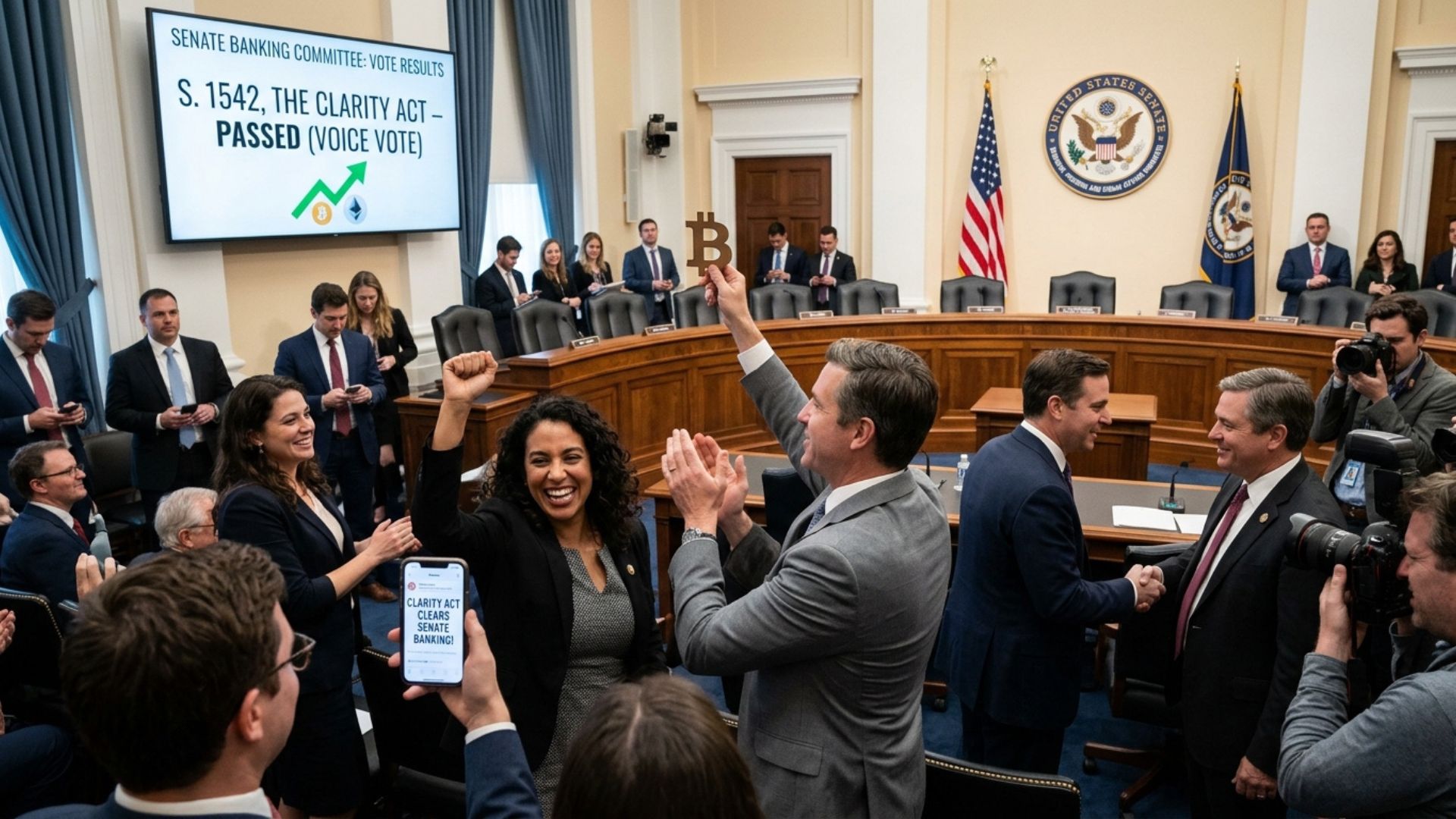
The crypto industry has achieved a landmark legislative victory. On May 14, 2026, the Clarity Act—formally known as the Digital Asset Market Clarity Act of 2025—advanced through the Senate Banking Committee with a 15-9 bipartisan vote, marking the first major hurdle for the most comprehensive piece of digital asset legislation ever to proceed through Congress. This monumental approval signals shifting political dynamics and sets the stage for what could be transformative cryptocurrency regulation in the United States.
Clarity Act and Its Significance
The Clarity Act represents a watershed moment for the blockchain and crypto industry, ending years of regulatory uncertainty that have plagued entrepreneurs, investors, and digital asset companies. For decades, the cryptocurrency market operated in what Senate Banking Committee Chair Tim Scott called a “regulatory gray zone,” where businesses faced conflicting guidance from multiple federal agencies and unclear legal frameworks that stifled innovation while creating compliance nightmares.
What makes the Clarity Act so critical is its comprehensive approach to establishing clear rules of the road for digital asset regulation. The legislation aims to create distinct, non-overlapping jurisdictions between the Securities and Exchange Commission (SEC) and the Commodity Futures Trading Commission (CFTC), eliminating the regulatory ambiguity that has defined the sector for years.
The digital asset framework outlined in the Clarity Act classifies assets as either securities or commodities, a distinction that has been hotly debated since Bitcoin’s emergence in 2009. This clear categorization addresses a fundamental gap in financial regulation.
The Senate Committee Vote: A Bipartisan Breakthrough
The 15-9 vote that advanced the Clarity Act out of committee came after months of contentious negotiations, failed compromise attempts, and genuine doubt about whether the legislation could secure any Democratic support. The breakthrough came at the eleventh hour when Senate Banking Committee Chairman Tim Scott made a procedural maneuver to allow additional amendments to be considered—a move that ultimately swayed two Democratic senators to cross party lines in favor of the bill.
How the Crucial Bipartisan Coalition Formed
Senator Ruben Gallego (D-Arizona) and Senator Angela Alsobrooks (D-Maryland) joined all Republican members of the committee to vote for the Clarity Act, providing the bipartisan legitimacy the measure needs to advance toward a full Senate floor vote. Both senators had been deeply involved in negotiations with cryptocurrency industry representatives, technology advocates, and Republican leadership to hammer out compromises on contentious provisions.
The broader committee dynamics revealed deep divisions but also unexpected common ground. Senator Mark Warner (D-Virginia), who has worked extensively with Republicans on the bill despite his reservations, described his journey as moving from “crypto hell” toward “crypto heaven,” settling for now in “crypto purgatory.” His comment reflected the genuine challenge lawmakers face in balancing consumer protection, financial stability, innovation, and compliance requirements.
Chair Scott himself emphasized the urgency of providing clarity to the industry, saying: “For years, the digital frontier was trapped in a regulatory gray zone. Developers, entrepreneurs and investors were left with uncertainty. They faced confusion and enforcement actions, when instead, the government should have been crafting clear rules of the road.”
The Stablecoin Yield Debate: The Central Flashpoint
Perhaps the most contentious issue that nearly derailed the Clarity Act—and consumed the vast majority of committee discussion—was stablecoin yield, a seemingly technical provision with massive economic implications. This debate pitted the banking industry directly against the cryptocurrency sector, with both sides arguing existential stakes.
What Is Stablecoin Yield?
Stablecoins are cryptocurrencies designed to maintain a stable value by being pegged to assets like the US dollar. Assets like USDC (Circle), USDT (Tether), and RLUSD (Ripple) are all pegged 1:1 to the US dollar. The question at hand: should crypto companies be permitted to offer interest-like payments or rewards to users who simply hold stablecoins in their digital wallets?
The Banking Industry’s Concerns
The banking sector vehemently opposed unrestricted stablecoin yields, arguing that such payments would cannibalize traditional bank deposits and reduce available capital for lending. Major financial institutions warned that allowing crypto companies to offer competitive interest rates on stablecoins would fundamentally undermine the traditional banking model, potentially destabilizing the financial system and reducing resources available for business loans, mortgages, and other essential credit products.
Banks also raised consumer protection concerns, claiming that yield-bearing stablecoins could blur the line between savings products and speculative assets, potentially misleading unsophisticated investors about risk levels. The American Bankers Association lobbied intensively against any language that would permit such yields.
The Crypto Industry’s Position

The cryptocurrency industry, represented by major firms like Coinbase, Ripple, and Circle, countered that the banking industry’s true concern was protecting monopolistic margins rather than protecting consumers. Brian Armstrong, Coinbase’s CEO, publicly stated that the banking industry’s opposition to stablecoin yields was fundamentally about protecting bank profits rather than consumers. For companies like Coinbase, where stablecoin-related revenue represented nearly 20% of total income in recent quarters, this provision was existential.
The crypto sector argued that the proposed language actually addressed legitimate concerns by restricting rewards to instances where stablecoins are actively used in spending, rather than simply held. This activity-linked incentive structure theoretically addresses law enforcement concerns about money laundering while permitting legitimate network usage rewards.
The Compromise Reached
The final version approved by the Senate Banking Committee incorporates compromise language that permits stablecoin rewards or incentives only when digital assets are spent or used in transactions—not when held passively. This distinction, which crypto advocates championed, means companies can incentivize stablecoin activity without creating what the banking sector feared would be competing savings products. However, significant questions remain about how this compromise will be implemented and enforced, and concerns linger from both sides about whether the language adequately addresses their fundamental objections.
Who Championed the Clarity Act
The legislation enjoyed support from an unusually diverse coalition for such technically complex financial regulation, reflecting how broadly beneficial comprehensive digital asset regulation could be for the American economy.
Industry Advocates
Major cryptocurrency companies including Coinbase, Circle, Ripple, and Andreessen Horowitz have been the most visible supporters, as they stand to benefit from regulatory clarity that would enable them to expand operations and attract institutional capital. These companies argue that clear rules would help them become better compliant enterprises while driving innovation in the United States rather than abroad. Industry groups like the Blockchain Association and the Digital Chamber have coordinated advocacy efforts, and in April 2026, over 100 crypto companies sent a joint letter to Senate leadership urging prompt passage.
White House Support
The Trump administration has actively supported the Clarity Act, with White House economic advisers pushing for its passage and facilitating negotiations between warring factions. The administration’s enthusiasm, while partly rooted in genuine belief in regulatory clarity, also reflects the Trump family’s substantial personal financial interests in the crypto sector through ventures like World Liberty Financial and holdings in meme coins.
Opposition and Remaining Concerns
Despite the committee approval, significant constituencies remain deeply skeptical of the Clarity Act and worry it prioritizes industry interests over consumer protection and financial stability.
Law Enforcement and Anti-Money Laundering Advocates
Law enforcement agencies argue that the Clarity Act doesn’t do enough to prevent illicit financial transactions using digital assets and could actually hamper efforts to catch bad actors exploiting cryptocurrency for money laundering, sanctions evasion, and financing terrorism. These agencies worry that the bill prioritizes industry convenience over the tools law enforcement needs to combat financial crime. Amendments specifically aimed at strengthening sanctions authority and anti-money laundering provisions failed during committee proceedings, raising concerns that these gaps will persist through subsequent legislative stages.
Labor and Retirement Security Groups
Major labor organizations, including the AFL-CIO, have warned that legitimizing and promoting the crypto industry through this legislation could jeopardize financial stability and, by extension, the retirement and pension accounts of millions of American workers. These groups worry that explosive growth in unproven digital assets could contribute to financial instability that would ultimately harm working families.
Ethics and Conflict-of-Interest Advocates
Senator Elizabeth Warren (D-Massachusetts) and other Democrats have raised serious concerns about ethical conflicts of interest, specifically regarding government officials and political leaders profiting from crypto ventures. An amendment specifically addressing this issue—proposed by Senator Chris Van Hollen (D-Maryland)—would have banned government officials, including the president, from maintaining business interests in the crypto industry. This amendment failed 11-13, with Republicans blocking the measure. The failure to address these ethics provisions remains a significant sticking point for Democratic support on the Senate floor.
Consumer Protection Concerns
Progressive Democrats have consistently argued that the bill prioritizes crypto innovation over consumer protection, pointing to the massive losses retail investors have experienced from crypto market volatility and fraud. Senator Sherrod Brown and others have emphasized that the bill doesn’t adequately protect unsophisticated retail investors who may not understand the substantial risks involved in cryptocurrency trading and holding.
The Legislative Path Forward: Still Considerable Obstacles Remain
While the Senate Banking Committee approval represents genuine progress, significant hurdles remain before the Clarity Act can become law. The path forward requires navigating a complex and time-sensitive legislative obstacle course.
Senate Agriculture Committee Reconciliation
The Clarity Act exists in two parallel Senate versions that must eventually be merged. While the Senate Banking Committee has now approved its version (covering SEC-related elements, investor protection, and stablecoin regulation), the Senate Agriculture Committee previously approved its own version covering CFTC-related elements, commodity market oversight, and derivatives regulation. These two Senate bills must be reconciled into a single measure before a full Senate floor vote becomes possible—a process that often takes weeks or months and can uncover new points of contention.
Full Senate Floor Vote
Once the two Senate committee versions are merged, the combined bill requires a Senate floor vote. Given the narrow margins and continued Democratic skepticism, Clarity Act supporters will need to secure at least 60 votes to overcome potential filibuster, a high bar that may require further compromise. Industry observers and Senator Kirsten Gillibrand have indicated the vote must occur by August 2026 to avoid the gridlock that typically accompanies midterm campaign season.
House Reconciliation
The House of Representatives passed its own version of the Clarity Act in July 2025 with a 294-134 bipartisan vote. Before a bill can reach President Trump’s desk, the House and Senate versions must be reconciled—a potentially contentious process that could reopen settled disputes or introduce new ones. Given the technical complexity of the legislation and the diverse interests involved, this reconciliation phase presents another critical juncture.
The Midterm Election Deadline
Every observer of this legislation acknowledges the same deadline: November 2026 midterm elections. If Republicans lose control of the Senate in those elections—a historically likely occurrence for the sitting president’s party—the entire legislative dynamics would shift dramatically. The crypto industry’s primary political leverage flows from Republican leadership.
What the Clarity Act Means for the Crypto Industry
The advancement of the Clarity Act through the Senate Banking Committee represents a historic validation of cryptocurrency as a legitimate asset class worthy of comprehensive federal regulation. The implications extend far beyond the immediate legislative success.
Enabling Innovation and Institutional Participation
Clear digital asset regulation would remove a major barrier to institutional adoption of cryptocurrency. Banks, insurance companies, and asset managers have been reluctant to develop crypto-related products and services due to regulatory uncertainty. With clearly defined rules of the road, these institutions could confidently offer digital asset products to their clients, potentially catalyzing massive growth in the sector.
Establishing America’s Leadership
Supporters argue that without clear crypto regulation, entrepreneurial talent and capital will migrate to more crypto-friendly jurisdictions like El Salvador, Dubai, and Singapore. The Clarity Act represents a commitment to keeping the United States at the forefront of financial innovation and blockchain technology development.
Creating Jobs and Economic Growth
Comprehensive cryptocurrency regulation would enable growth of a robust domestic industry, creating high-skilled jobs in blockchain development, DeFi engineering, and digital asset custody. The crypto sector already employs thousands and contributes meaningfully to the economy; clearer rules could multiply these contributions.
Broader Implications for Financial Regulation
The Clarity Act’s progression through Congress reflects a broader shift in how policymakers approach financial innovation and emerging technologies. Rather than attempting to ban or severely restrict cryptocurrency, Congress is moving toward a regulatory framework that acknowledges digital assets as permanent features of the financial landscape.
This approach mirrors how financial regulation evolved in previous eras, moving from prohibition or heavy-handed restriction toward thoughtful, principles-based regulation that balances innovation, consumer protection, and financial stability. The Clarity Act represents the legislative system attempting to catch up with technological reality.
Conclusion
The May 14, 2026 Senate Banking Committee approval of the Clarity Act marks a pivotal moment in the history of cryptocurrency regulation. After years of regulatory uncertainty, enforcement actions based on unclear rules, and entrepreneurial frustration, the path toward comprehensive digital asset regulation has finally cleared a major legislative hurdle. The 15-9 bipartisan vote, secured through last-minute negotiation and procedural maneuvering, demonstrates that crypto policy can transcend typical partisan divisions when structured appropriately.
The remaining challenges are substantial but not insurmountable. The reconciliation of two Senate bills, securing 60 Senate votes, and coordinating with the House all require sustained momentum and further compromise. The August 2026 deadline before the midterm campaign season creates genuine time pressure, but also focuses minds on the stakes involved. If the crypto industry and its allies maintain their coalition, manage remaining disputes over consumer protection, ethics provisions, and anti-money laundering safeguards, and navigate the technical complexity of merging multiple legislative versions, the Clarity Act could become law by early 2027.
