


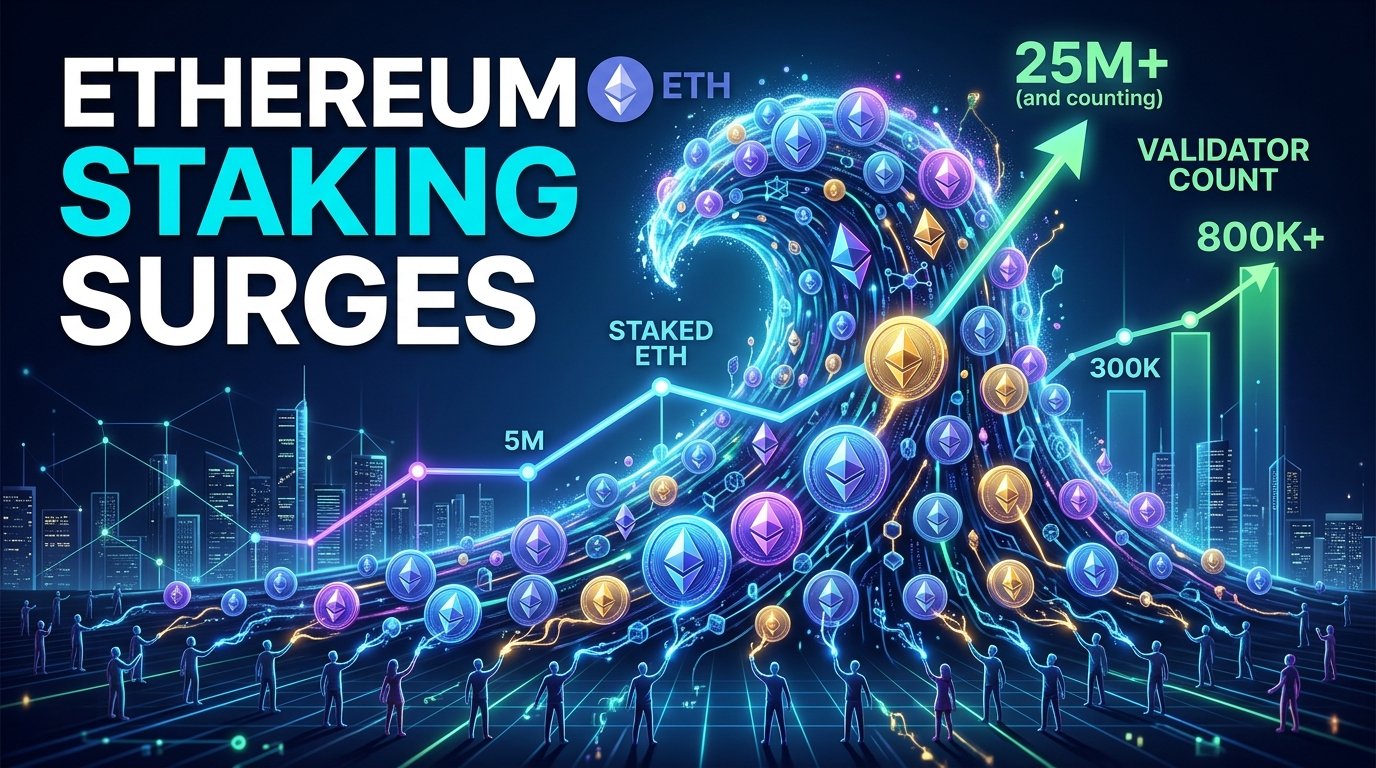
The Ethereum network continues to demonstrate remarkable resilience as ETH staking reaches unprecedented levels, even while the cryptocurrency price remains in a consolidation phase following significant leadership changes within the community. This paradox—where network activity thrives despite market uncertainty—reveals deeper truths about blockchain adoption and investor confidence in Ethereum’s long-term vision. As we examine the current landscape of Ethereum staking rewards and network participation, it becomes clear that the fundamentals driving the ecosystem remain stronger than ever, regardless of short-term price fluctuations or organizational transitions.
The surge in staking activity represents more than just financial opportunity for cryptocurrency investors. It reflects a fundamental shift in how participants engage with the Ethereum protocol, moving beyond speculation toward genuine network participation. Understanding these dynamics requires exploring the technical, economic, and psychological factors that make staking increasingly attractive to both institutional and retail participants.
The Current State of Ethereum Staking Growth
Ethereum staking has experienced explosive growth since the network transitioned to proof-of-stake in September 2022, fundamentally transforming how the blockchain secures itself. Today, more than 32 million ETH—worth billions of dollars at current valuations—remains locked in staking contracts, representing approximately 26% of the total Ethereum supply. This figure continues climbing steadily, indicating sustained confidence in the network’s future and the economic incentives embedded in the staking mechanism itself.
Mechanics Behind the Surge
The infrastructure supporting Ethereum staking has matured significantly over the past few years, making participation accessible to everyone from casual investors to large institutional players. Liquid staking derivatives, such as stETH, rETH, and cbETH, have eliminated the traditional barriers that once prevented participation, allowing users to stake their ETH while maintaining flexibility to trade or use their assets elsewhere. These innovations have democratized access to staking rewards, which currently hover around 3-4% annually, depending on network conditions and the specific staking service utilized.
The Beacon Chain and subsequent Ethereum upgrades established the technical foundation for efficient staking, but the real acceleration came from ecosystem solutions that wrapped the complexity of running validators into user-friendly applications. Staking service providers now manage hundreds of thousands of validators collectively, pooling resources and distributing rewards to millions of participants. This infrastructure development directly corresponds with the surge in total value staked on Ethereum, demonstrating how technical innovation drives network participation and blockchain adoption.
Why Investors Are Choosing Staking Despite Market Uncertainty
Even as ETH price fluctuates within a consolidation range, investors continue depositing substantial amounts into staking pools and validator contracts. This behavior suggests that market participants are making decisions based on long-term protocol value rather than immediate price movements. The consistent yield provided by staking rewards offers an attractive alternative to holding ETH passively, effectively transforming cryptocurrency holdings into income-generating assets. For traditional finance participants entering the crypto space, this income component provides psychological comfort similar to dividend-paying stocks or bond yields.
Additionally, the shift toward proof-of-stake consensus has fundamentally changed the narrative around Ethereum from energy-intensive speculation toward sustainable, economically rational participation. Environmental concerns that plagued proof-of-work systems no longer apply to Ethereum, removing a significant barrier to institutional adoption. This narrative shift has proven powerful, attracting capital from ESG-conscious investors who previously avoided cryptocurrency investments entirely.
The ETH Price Consolidation
Market Dynamics and Technical Factors
The ETH price currently exhibits characteristics typical of major consolidation phases, where strong support levels prevent sharp declines while resistance levels cap upside moves. This consolidation pattern, though frustrating for short-term traders seeking directional moves, actually represents healthy price discovery. The Ethereum network continued strengthening its fundamentals during this period, upgrading security protocols, improving scalability through layer-two solutions, and enhancing smart contract capabilities. These improvements may not immediately translate to price appreciation, but they establish prerequisites for sustainable long-term growth.
Consolidation phases often precede significant price movements in either direction, making them psychologically challenging for market participants. The narrative becomes unclear—is this the calm before a surge, or merely a pause before declining further? This uncertainty explains why many investors pivot toward the certainty of staking rewards, which provide measurable returns regardless of future price direction. A staker receiving 3.5% annual yield on their ETH holdings gains value with certainty, whereas price speculation offers only probabilistic returns with substantial downside risk.
Leadership Transitions and Their Impact on Sentiment
The recent leadership turmoil within Ethereum’s ecosystem has created additional uncertainty that could partially explain price consolidation. Leadership changes in decentralized projects are particularly sensitive, as they raise questions about vision alignment, technical direction, and governance stability. However, Ethereum’s structure as a leaderless protocol with distributed decision-making has proven more resilient than centralized alternatives during similar transitions. The network continued operating flawlessly, validators maintained security, and core development proceeded through established channels, demonstrating the strength of Ethereum’s decentralized architecture.
The separation between individual leadership figures and the protocol itself represents a crucial distinction that sophisticated investors understand but newcomers sometimes miss. Ethereum operates as a collective endeavor with hundreds of contributing developers, researchers, and community members. No single individual commands absolute authority, which provides stability during organizational changes but can create perception issues when prominent figures depart. The fact that Ethereum staking accelerated through this period suggests that informed participants recognize this structural resilience.
The Relationship Between Staking and Network Security
How Staking Strengthens Ethereum’s Foundation
Ethereum staking creates an economic security model fundamentally different from traditional consensus mechanisms. By requiring validators to stake capital and face penalties for misbehavior, the protocol transforms potential attackers into stakeholders with vested interests in network integrity. This elegant design ensures that attacking Ethereum becomes economically irrational—the cost of acquiring sufficient stake to launch an attack far exceeds any realistic gain from doing so. As staking participation increases, this security model strengthens exponentially.
The relationship between staked ETH and network security creates a virtuous cycle. Higher staking rates increase security, stronger security attracts institutional adoption, and institutional adoption increases demand for staking services and participation. This reinforcing dynamic explains why sophisticated investors remain bullish on Ethereum despite current price consolidation. They recognize that each ETH contributed to staking strengthens the network’s moat against competitors and attacks, enhancing long-term value protection.
Technical Resilience During Turbulent Periods
Throughout the recent period of leadership changes and market consolidation, Ethereum’s technical performance remained exemplary. Network uptime exceeded 99.99%, transaction finality times remained consistent, and smart contract execution continued without interruption. This operational excellence during a period of organizational transition demonstrates that Ethereum’s blockchain infrastructure operates independently of individual personalities or organizational structures. The network’s ability to maintain perfect functionality while external narratives swirled serves as powerful validation of its decentralized architecture.
This technical resilience translates directly into validator confidence. Those staking ETH and operating validators can point to documented network performance as evidence that their capital remains secure and their validator operations will continue generating rewards. When validators feel secure in the protocol’s stability, they commit capital more readily, creating the surge in staking we observe today.
Staking Rewards Economics and Investment Considerations
Current Reward Structures and Participation Models
Staking rewards on Ethereum are determined by network parameters including total staked ETH, number of validators, and transaction fees burned through EIP-1559. Currently, base layer rewards combined with priority fees create annual yields ranging from 3% to 4% for most participants, with variations based on network activity levels. These yields compare favorably to traditional fixed-income investments, particularly for a volatile asset class like cryptocurrency, making Ethereum staking increasingly attractive to portfolio managers constructing diversified digital asset allocations.
The variety of staking options available to different participant types ensures broad accessibility. Solo stakers running individual validators maintain maximum autonomy and receive full rewards but require technical expertise and capital commitment of 32 ETH. Staking pools allow participation with any amount of ETH, distributing rewards among participants while introducing minimal fees. Centralized exchanges offering staking services provide maximum convenience but concentrate capital and decision-making. This spectrum of options has enabled the surge in staking by accommodating diverse participant needs and technical abilities.
Risk Factors in Staking Participation
While Ethereum staking offers compelling rewards, participants must understand associated risks including slashing penalties for validator misbehavior, smart contract vulnerabilities in staking contracts, and smart contract risk from third-party service providers. Slashing penalties—while rare—can permanently reduce validator balances by up to 32 ETH for serious protocol violations. Sophisticated investors accept these risks as reasonable given the transparent economic model and historical safety record. The relative rarity of slashing events despite millions of validators operating for years suggests that the risk is genuinely small for honest participants.
The emergence of liquid staking derivatives introduces additional complexity regarding counterparty risk. When staking through a provider, participants depend on that provider’s technical competence, honesty, and financial stability. The collapse of FTX and similar incidents have heightened awareness of custody risk in crypto, yet demand for staking services continues growing because the underlying economics remain compelling despite these organizational risks.
What’s Next for Ethereum Staking and ETH Price
Anticipated Protocol Improvements and Developments
Ethereum’s development roadmap includes several initiatives that will impact Ethereum staking economics and network security positively. Proto-Danksharding and subsequent scaling improvements will increase transaction throughput, potentially increasing priority fees and thus validator rewards. Pectra upgrade and other planned enhancements aim to reduce minimum stakes, allowing smaller participants to solo validate without maintaining 32 ETH. These improvements suggest that staking participation will likely accelerate further as technical barriers diminish and reward potential increases.
The maturation of layer-two scaling solutions like Arbitrum, Optimism, and Polygon should increase transaction demand on Ethereum’s base layer, generating fees that benefit validators. As these Layer 2 solutions consume more user transactions, they simultaneously create more settlement activity on Ethereum mainnet, paradoxically strengthening demand for base-layer security provided by stakers. This symbiotic relationship between scaling and staking economics deserves greater recognition in investment discussions.
Market Sentiment and Price Trajectory Possibilities
The ETH price consolidation may reflect a temporary equilibrium before the market recognizes the value creation from Ethereum staking growth. Traditional financial markets often lag in recognizing fundamental improvements, meaning sophisticated investors position accordingly before mainstream recognition occurs. The current period, with staking participation accelerating despite price flatness, may represent precisely such an opportunity for informed participants. As more capital locks into staking contracts, the decreasing liquidity of tradeable ETH could exert upward pressure on price.
However, cryptocurrency markets remain unpredictable, and ETH price could consolidate further or decline before resuming an uptrend. The importance of understanding this distinction cannot be overstated—Ethereum staking fundamentals remain strong regardless of near-term price movements. For investors seeking yield on their digital assets and long-term exposure to the Ethereum ecosystem, current conditions represent attractive entry points despite the ambiguous price environment. Those primarily focused on short-term speculation should await clarity in the technical price structure before committing capital.
Leadership, Governance, and Long-Term Vision
The Decentralized Nature of Ethereum’s Development
The recent leadership transitions have highlighted a crucial strength of Ethereum’s structure—its resilience to individual departures. Unlike projects dependent on singular visionary figures, Ethereum benefits from distributed leadership across numerous core developers, researchers, and community stewards. This decentralization means that individual transitions, while potentially causing short-term sentiment shifts, rarely impact long-term development trajectories. The protocol’s direction emerges from community consensus through established governance processes rather than top-down decision-making.
This structural characteristic helps explain why Ethereum staking continued accelerating despite leadership turmoil that would have devastated centralized projects. Validators and stakers understand intellectually that Ethereum’s strength derives from its distributed nature, even if market sentiment sometimes temporarily reflects undue pessimism during organizational changes. The disconnect between operational resilience and sentiment volatility creates opportunities for informed participants willing to look beyond short-term narratives.
Community Consensus and Future Direction
The Ethereum community demonstrates remarkable maturity in debating technical directions and protocol improvements through formal governance structures like Ethereum Improvement Proposals. This transparent process builds confidence among staking participants that their capital remains secure within a framework subject to distributed decision-making. Rather than risking concentration of power in individual hands, Ethereum distributes authority across the ecosystem, creating redundancy and resilience.
The staking participation surge during a period of leadership changes actually validates this governance structure’s effectiveness. If market participants truly feared Ethereum’s future due to leadership transitions, staking participation would decline as investors withdrew capital. Instead, the opposite occurred, suggesting that informed participants recognize Ethereum’s fundamental strength despite surface-level organizational challenges.
Conclusion
The apparent paradox of Ethereum staking accelerating while ETH price consolidates and leadership transitions create headline turbulence actually reveals sophisticated market dynamics at work. Informed investors recognize that network fundamentals—the actual security, scalability, and economic models underlying Ethereum—continue strengthening regardless of temporary sentiment fluctuations. The surge in staking reflects growing confidence in Ethereum’s decentralized architecture’s ability to deliver long-term value creation.
The current environment presents a compelling investment thesis for those willing to look beyond short-term price movements. Staking rewards provide measurable yield, network improvements promise future scaling benefits, and the protocol’s demonstrated resilience during organizational transitions provides confidence in long-term security. Whether ETH price consolidation gives way to appreciation or further consolidation, the fundamentals supporting Ethereum staking remain intact and continue strengthening.
For participants seeking exposure to blockchain technology while generating meaningful returns, Ethereum staking offers an increasingly mature, well-supported infrastructure serving millions of validators globally. The next phase of Ethereum’s evolution—marked by scaling solutions, protocol improvements, and broader institutional adoption—will likely validate the wisdom of those who chose participation over speculation during periods of uncertainty and leadership transition.
