


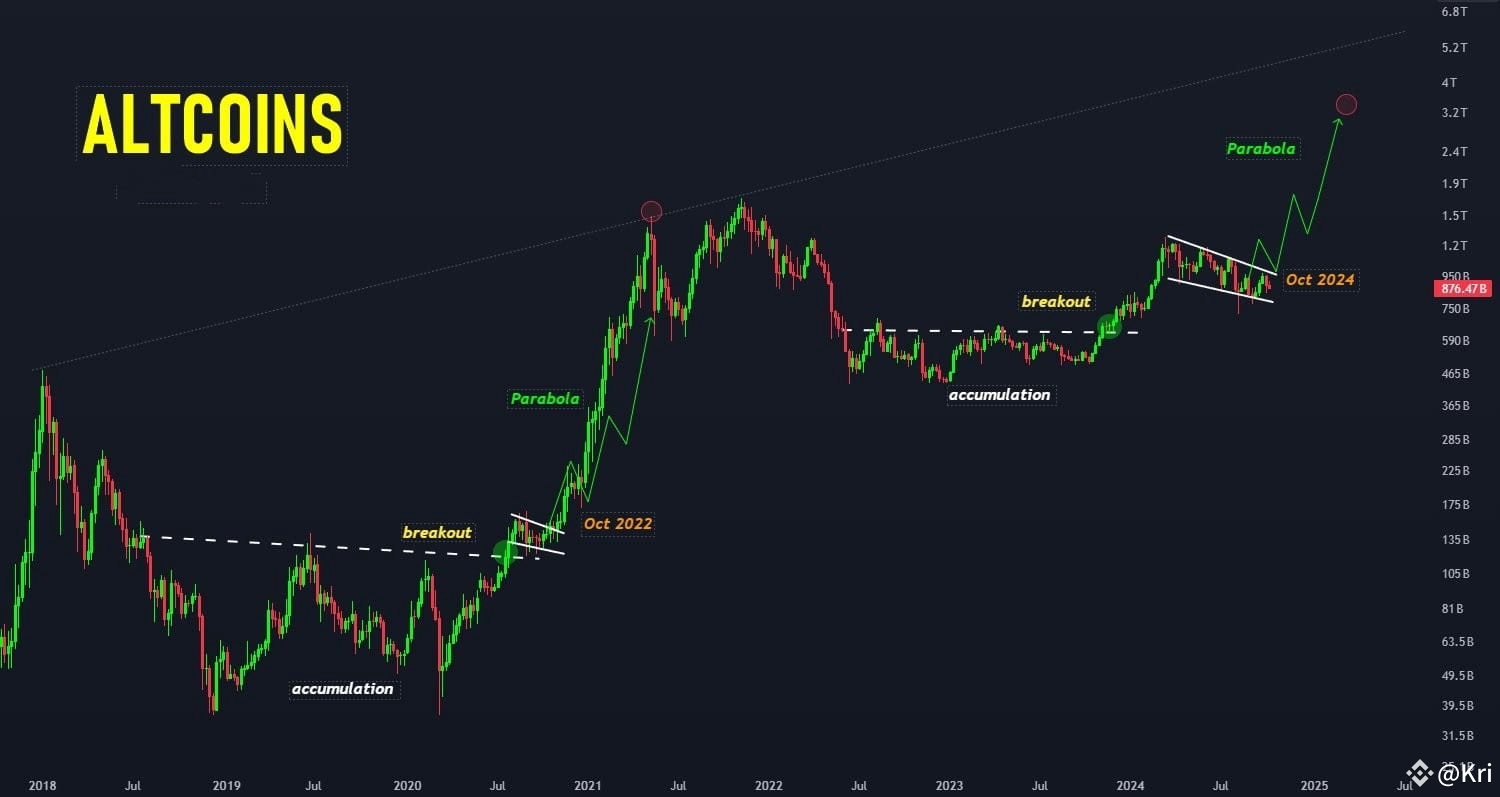
The cryptocurrency market is experiencing something far more sinister than a temporary crash. While Bitcoin and Ethereum have managed to maintain relative stability, the broader altcoin market—everything outside the two largest digital assets—has shed nearly a quarter of its value in the first half of 2026. This 23% decline in the ex-Bitcoin and ex-Ethereum crypto market, which now trades at approximately $666 billion, represents not an acute market event but rather a slow, structural altcoin depression with distinct causes, shifting capital flows, and a widening gap between winners and losers.
The distinction matters because the altcoin collapse is fundamentally different from typical bear markets. Traditional cryptocurrency market corrections end relatively quickly, characterized by sharp liquidations and rapid capitulation. The current situation, however, unfolds like a structural depression—a persistent deterioration in investor sentiment combined with meaningful shifts in how capital allocates across the digital asset landscape. This altcoin downturn reveals uncomfortable truths about which digital currencies have genuine utility and which exist primarily as vehicles for retail speculation. For investors, traders, and blockchain entrepreneurs, understanding this altcoin depression has become essential to navigating 2026’s fragmented cryptocurrency market.
The Scale of the Altcoin Market Collapse
The Visible Decline and Hidden Severity
The headline number—a 23% decline in the ex-Bitcoin and ex-Ethereum market cap—obscures the true severity of the altcoin market depression. When examining this aggregate statistic, the decline appears somewhat survivable. However, upon decomposition, the damage becomes dramatically more severe. The aggregate market cap figure includes stablecoins, exchange tokens, and the handful of layer-1 blockchains that have managed to retain investor confidence. These defensive assets have preserved value even as the broader altcoin ecosystem fractured.
Descending the market capitalization hierarchy reveals far grimmer numbers. Mid-cap altcoins have experienced drawdowns ranging from 60% to 80% below their 2025 peaks. The memecoin complex, always more speculative than utility-driven, has suffered even steeper losses. The truly distressing data emerges at the sub-100 million dollar market cap tier, where thousands of smaller digital tokens have become functionally illiquid, trading on volumes of just a few thousand dollars daily. This token market has essentially hollowed out from the bottom, demonstrating that the altcoin depression has a distinctly bottom-heavy character.
The altcoin market analysis reveals that liquidity has not disappeared from the cryptocurrency ecosystem; rather, it has retreated inward along the risk curve, concentrating in progressively safer assets. This redistribution of investment capital explains why some digital currencies have stabilized while others have collapsed into effectively illiquid conditions.
The Three Structural Forces Behind the Altcoin Depression
1. Bitcoin Dominance and the Rise of Institutional Crypto Access
Bitcoin dominance—the percentage of total cryptocurrency market capitalization represented by BTC—has ground relentlessly higher throughout 2026. This expansion in Bitcoin’s market share reflects a fundamental shift in how institutional investors access digital assets. The approval of Bitcoin ETFs in early 2024, followed by Ethereum ETF launches, created a new category of cryptocurrency exposure that institutional capital allocators could access through familiar, regulated vehicles. These exchange-traded funds provided institutional investors with straightforward exposure to Bitcoin and Ethereum without requiring them to navigate the technical complexity of blockchain networks, digital wallets, or crypto exchanges.
Critically, the Bitcoin ETF and Ethereum ETF ecosystem was architected to provide institutional exposure primarily to these two assets. The structure of these crypto investment products naturally concentrated capital on the largest, most established digital currencies. This institutional-grade cryptocurrency access has systematically starved smaller digital tokens of the capital flows that previously sustained altcoin rallies during bull markets. Institutional investors seeking digital asset exposure now have little reason to venture beyond Bitcoin and Ethereum when their fiduciary obligations demand portfolio simplicity and asset verification.
2. Token Supply Glut and Issuance Economics
The second force depressing the altcoin market operates at the level of token economics and supply dynamics. Unlike Bitcoin, with its fixed supply cap of 21 million, most altcoins employ more generous tokenomics designed to incentivize ecosystem participation through token rewards. This token issuance model created a persistent supply overhang as miners, validators, and protocol developers continuously released new tokens to the market.
Throughout the 2024-2025 cryptocurrency bull market, this token supply expansion mattered little because demand from retail investors exceeded the supply of new tokens. However, when retail participation retreated—reflected in declining wallet creation metrics and cryptocurrency exchange trading volume—the equation reversed. Suddenly, token supply dynamics became prohibitively deflationary. Protocols that had relied on enthusiastic retail demand to absorb their token emissions discovered they could not generate sufficient selling pressure to maintain prices. This altcoin supply dynamic has become a structural headwind that will persist regardless of market sentiment recovery.
3. Marginal Retail Buyer Absence and Liquidity Withdrawal
The third force concerns the conspicuous absence of the retail crypto buyer that historically drove altcoin seasons. Metrics tracking cryptocurrency adoption—new wallet creation, exchange platform downloads, and app installation rates—have all retreated to multi-year lows. The historical pattern held that after Bitcoin and Ethereum established new price highs, retail investors would rotate capital into smaller digital assets in search of higher returns, creating altcoin rallies that sometimes outperformed the leading digital currencies by orders of magnitude.
This capital rotation mechanism has completely broken down in 2026. Part of the explanation involves investor sentiment: the Crypto Fear and Greed Index touched readings of 12 in June 2026, levels previously seen only during the depths of prior crypto market cycles. When fear reaches such extreme levels, retail investors typically abandon the market altogether rather than shift to speculative altcoin positions. Additionally, the institutional investors who have partially replaced retail capital in driving crypto market movements have little interest in the high-volatility, low-liquidity digital assets that comprise most of the altcoin market.
The Anatomy of Surviving Altcoins: What Separates Winners from Victims
Fee-Generating Assets and Revenue Mechanisms
Beneath the wreckage of the altcoin market, a small cohort of digital tokens behaves as if the altcoin depression does not exist. This exceptional group uniformly possesses one critical characteristic: cash flow mechanisms or revenue-generating business models built directly into their protocol economics.
Hyperliquid (HYPE), a perpetual trading exchange, has maintained a position near all-time highs despite the broader altcoin downturn. The token succeeds because it captures economic value from the exchange activity that occurs on its platform, distributing this cash flow to token holders through buyback mechanisms and direct dividend distributions. Similarly, Aave (AAVE), a decentralized lending protocol, has outperformed most altcoins because the protocol generates substantial fee revenue from the lending and borrowing activity that occurs on its network.
These fee-generating tokens represent a fundamental category shift within the altcoin ecosystem. They function analogously to equity shares in traditional corporations—their token value derives from an underlying stream of revenue or cash flows rather than from speculative expectations about future adoption. This tokenomics structure proved decisive during the altcoin depression because it provided a valuation anchor independent of investor sentiment or retail demand.
Tokens with Explicit Buyback Programs
A secondary cohort of surviving altcoins features tokens whose protocols explicitly commit to token buybacks, using protocol revenue to repurchase and burn outstanding tokens. This buyback mechanism operates similarly to share buyback programs in traditional corporations—it reduces the circulating supply of the token, creating deflationary pressure that can offset or reverse downward price momentum.
One lending protocol token increased 40% in a single month explicitly because market participants recognized that the protocol’s buyback commitment would systematically reduce available supply while the protocol continued generating trading fees. This token buying by the protocol itself created a hidden floor beneath the token price that retail market participants could not replicate through shorting or negative sentiment alone.
Utility-Based Tokens with Nonspeculative Value Drivers
The final category of altcoins that have resisted the altcoin depression comprises tokens whose utility does not depend primarily on retail speculation or investor sentiment. Layer-1 blockchain tokens that miners or validators require to secure their networks, or utility tokens essential to protocol operation, maintain baseline demand even during severe bear markets because protocols must function regardless of market conditions.
This structural demand has proven far more resilient than the speculative demand that sustained previous altcoin rallies. When investor sentiment deteriorates, speculative demand evaporates immediately. By contrast, utility-driven demand adjusts only gradually and typically to a lesser degree.
Bitcoin and Ethereum’s Divergent Trajectories
Bitcoin’s Relative Resilience
Bitcoin, despite experiencing significant price volatility, has managed to hold up considerably better than the broader altcoin market. BTC trading near $64,700 represents a substantial decline from the all-time high above $126,000 recorded in October 2025, but the recovery from June’s lows below $59,000 demonstrates the digital asset’s capacity to stabilize even amid severe market stress.
Bitcoin’s outperformance relative to altcoins reflects several factors. First, the digital currency benefits from its status as the crypto market’s primary entry point for new institutional capital. New crypto investment vehicles disproportionately flow through Bitcoin, creating a structural bid underneath the digital currency. Second, Bitcoin’s fixed supply cap and scarcity narrative provide valuation support independent of near-term market sentiment. Third, Bitcoin trades with substantially higher liquidity than any altcoin, enabling institutional investors to take positions without moving market prices significantly.
Ethereum’s Structural Challenges
Ethereum has suffered far more than Bitcoin, reflecting the broader altcoin market dynamics despite its position as the second-largest digital currency. ETH recently closed three consecutive red quarters for the first time in its trading history, with the blockchain’s native token declining 28% in the second quarter alone. Ethereum’s descent to approximately $1,740 represents a 65% decline from its August 2025 peak near $5,000, placing ETH among the worst-performing assets in the cryptocurrency space.
The divergence between Bitcoin and Ethereum highlights how blockchain network characteristics influence digital asset performance. Ethereum’s value proposition depends partially on ecosystem activity—smart contract executions, decentralized finance transactions, and token issuance on the Ethereum network. When cryptocurrency market sentiment deteriorates, ecosystem activity contracts sharply, eliminating much of Ethereum’s value driver. Bitcoin, by contrast, maintains value primarily as a store of value and inflation hedge, characteristics that hold independent of broad market sentiment or blockchain ecosystem dynamics.
Notable Altcoin Casualties and Severity Metrics
Individual Token Declines
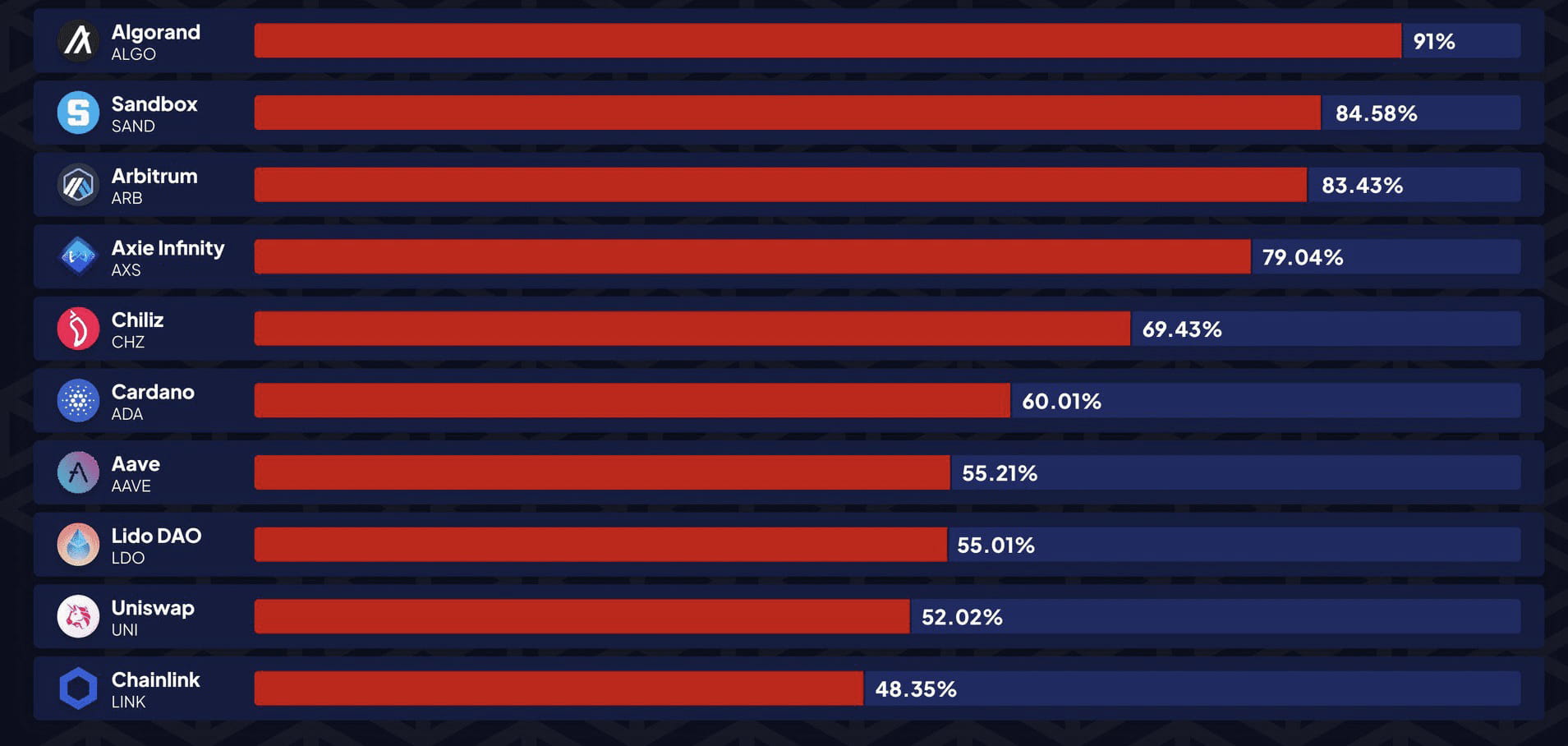
The individual altcoin price data tells a story far grimmer than aggregate market capitalization figures suggest. Solana, once a leading layer-1 blockchain contender, has descended to the high $70 to low $80 range, representing a fall from multi-hundred dollar highs achieved during the 2024-2025 bull market. Worldcoin experienced an 80% collapse over a seven-month period, erasing virtually all gains from its earlier market rally. Pi Network, which received substantial retail attention and optimistic sentiment, has printed all-time lows 96% below its peak, rendering early participants’ investments nearly worthless.
These individual altcoin collapses demonstrate that the altcoin depression operates indiscriminately, destroying value across multiple categories of digital tokens regardless of their narrative appeal, technology, or team composition. Worldcoin, backed by a notable entrepreneur and pursuing a seemingly novel identity technology, could not protect its token price from the market’s systematic altcoin liquidation. Solana, despite legitimate technological achievements and ecosystem developer activity, has declined alongside the broader altcoin market. No narrative or technology differentiation has proven sufficient to insulate altcoins from the structural depression affecting the digital asset class.
Market Sentiment at Cycle Lows
The Crypto Fear and Greed Index provides a quantitative measure of market sentiment. This index, which ranges from 0 to 100, reached readings of 12 in June 2026—metrics previously observed only during the absolute trough of preceding cryptocurrency market cycles. When the Fear and Greed Index reaches such extreme readings, it signals that investor capitulation has become nearly complete. Long-only investors have largely exited the market, and cryptocurrency price movements depend primarily on day-to-day technical dynamics and limited retail participation rather than on macro market sentiment.
The Distinction Between Crash and Depression
Why This Is Not a Traditional Crash
Cryptocurrency market participants accustomed to the cycles of 2017, 2021, and 2022 might expect the current downturn to follow a familiar pattern: severe price decline, panic liquidation, eventual capitulation, and then swift recovery. The altcoin depression does not conform to this pattern. Traditional market crashes exhibit distinctive characteristics: they involve sharp, rapid price declines that exhaust themselves within weeks or months, often followed by technical bounces and eventual recovery.
The altcoin market’s 23% decline over six months represents a slow, grinding deterioration rather than a catastrophic shock. Individual altcoins have not crashed uniformly; instead, the market has hollowed out from the bottom, with smaller tokens becoming progressively more illiquid while larger, more defensible assets have held value better. This structural pattern indicates that the market is not experiencing a traditional crash but rather a depression characterized by shifting capital allocation and fundamental reassessment of which digital assets possess durable value.
The Persistence of Depression Conditions
Market depressions differ from crashes in their persistence. A crash ends; a depression develops its own internal dynamics that perpetuate weakness. The altcoin depression exhibits characteristics suggesting extended duration. Institutional capital has redirected toward Bitcoin and Ethereum ETFs, creating a new structural demand for these digital assets while systematically excluding smaller altcoins. Token supply overhang will persist regardless of market sentiment recovery because the protocols generating these token emissions operate independently of investment demand. The retail investor base, historically the marginal buyer during altcoin rallies, has retreated from the cryptocurrency market entirely, with adoption metrics at multi-year lows.
Each of these factors independently would create market headwinds; collectively, they establish a self-reinforcing cycle where declining altcoin prices reduce trading volume, which increases bid-ask spreads, which further discourages trading, which exacerbates illiquidity. Breaking out of this depression cycle will require either restoration of retail capital flows at massive scale or a fundamental change in how institutional capital allocators view the altcoin market.
Capital Flows and the Retreat to Quality
Bitcoin ETF Flows and Institutional Capital Consolidation
The Bitcoin ETF complex has institutionalized a form of cryptocurrency exposure that explicitly excludes the altcoin market. When institutional investors receive capital designated for digital asset allocation, they deploy that capital primarily through established Bitcoin ETF vehicles rather than directly purchasing altcoins or acquiring altcoin holdings through cryptocurrency exchanges. This capital flow dynamic has fundamentally altered how institutional money circulates through the cryptocurrency ecosystem.
Bitcoin ETF inflows reached record levels during the 2024-2025 bull market, but Deutsche Bank research indicates that these flows have reversed sharply in 2026. Bitcoin ETFs have experienced outflows totaling $6 billion over a six-week period, marking the longest losing streak since these investment products launched in early 2024. The significance of this flow reversal extends beyond Bitcoin’s immediate price dynamics. These outflows represent institutional capital exiting the digital asset class entirely—capital that, when it returns, will likely flow back into Bitcoin rather than dispersing across the altcoin spectrum.
Stablecoin Concentration and the Flight to Safety
While altcoins have experienced indiscriminate price declines, stablecoins—digital tokens pegged to fiat currencies like the U.S. dollar—have not only preserved value but actually increased in aggregate supply. Stablecoin market capitalization has continued growing even as the broader cryptocurrency market contracted, indicating that investors and traders actively converted holdings of volatile altcoins into stablecoins to preserve capital value.
This capital rotation from altcoins to stablecoins exemplifies the flight to safety dynamics that characterize the altcoin depression. Investors who recognize the altcoin market’s structural weakness have liquidated digital token holdings and parked proceeds in stablecoins, effectively removing this capital from the altcoin ecosystem while maintaining cryptocurrency market exposure. The stablecoin concentration phenomenon demonstrates that capital has not left the digital asset class entirely; rather, it has retreated to the safest subset of cryptocurrency assets, creating a bifurcated market where Bitcoin, Ethereum, and stablecoins prosper while traditional altcoins wither.
What Recovery Would Require: Three Essential Conditions
Restoration of Retail Capital Flows
The first requirement for altcoin market recovery involves restoration of retail investor participation at significant scale. The cryptocurrency market’s historical pattern shows that altcoin rallies depend critically on retail enthusiasm. During periods when retail capital floods into crypto exchanges seeking exposure to speculative digital assets, altcoin prices can multiply many times over. Conversely, when retail interest evaporates—as measured by wallet creation metrics and exchange platform engagement—altcoin prices naturally compress.
Restoration of retail participation would require either a catalyst that reignites investor enthusiasm for digital assets broadly, or a sustained Bitcoin or Ethereum price rally that spills over into altcoin interest. Currently, the crypto market’s extreme fear readings and weak adoption metrics suggest that retail capital restoration remains distant. Investors who experienced losses during the 2022-2023 bear market and the subsequent 2026 altcoin depression have largely abandoned the cryptocurrency space, creating a significant challenge for attracting retail capital inflows sufficient to drive altcoin recovery.
Protocol-Level Tokenomics Restructuring
The second requirement involves meaningful restructuring of token economics at the protocol level. Many altcoin projects operate with token supply dynamics fundamentally misaligned with demand conditions. Protocols that emit tokens continuously to miners, validators, or developers without offsetting token burning mechanisms accumulate supply that exceeds investor demand, creating persistent price pressure.
Altcoin projects capable of recovering from the current depression will likely be those that address token supply dynamics proactively. This might involve implementing buyback mechanisms that systematically purchase and burn tokens, reducing circulating supply. Alternatively, projects might restructure their token emission schedules, reducing the rate at which new tokens enter circulation. Some protocols might transition from inflationary tokenomics to deflationary models by implementing fee-burning mechanisms that destroy tokens rather than accumulating them in protocol treasuries.
Institutional Capital Reallocation
The third essential condition requires institutional investors to develop cryptocurrency investment strategies that extend beyond Bitcoin and Ethereum. This represents a meaningful shift from current practice, where institutional crypto exposure concentrates overwhelmingly in the two largest digital assets. Institutional reallocation toward altcoins would likely require either regulatory breakthroughs that enable altcoin ETF products analogous to existing Bitcoin and Ethereum ETFs, or a gradual process of institutional risk acceptance toward smaller digital assets with proven business models and revenue-generating mechanisms.
The institutional capital reallocation scenario seems partially viable for altcoins that have transformed themselves into cash flow-generating assets similar to Hyperliquid or Aave. These tokens offer institutional investors something resembling equity-like exposure to protocol revenue, a characteristic that makes them potentially palatable to institutional investors with fiduciary obligations. However, for altcoins that remain primarily speculative, institutional participation seems unlikely absent a fundamental shift in how institutional investors perceive crypto risk.
The Altcoin Depression’s Potential End State
A Permanently Smaller Altcoin Ecosystem
One realistic outcome of the altcoin depression involves permanent contraction of the altcoin market relative to Bitcoin and Ethereum. The institutional crypto access created by Bitcoin and Ethereum ETFs has established a new structural equilibrium where these two digital assets permanently capture a larger share of cryptocurrency capital flows. Additionally, the retail investor base that historically powered altcoin rallies has been substantially diminished through repeated market cycles that destroyed retail capital.
This scenario would result in a much smaller but potentially more healthy altcoin ecosystem where only tokens with genuine utility and business models survive. **Thousands of lower-quality altcoins would eventually become illiquid and disappear from trading venues entirely. The surviving altcoins would be characterized by strong tokenomics, revenue-generating mechanisms, or genuine protocol utility, creating an ecosystem of digital assets that resemble mature businesses rather than pure speculation vehicles.
The Two-Tier Cryptocurrency Market
A second potential outcome involves the emergence of a permanent two-tier cryptocurrency market. Tier One would consist of Bitcoin, Ethereum, and perhaps a small handful of layer-1 blockchains that have established sufficient institutional adoption and ecosystem scale. Tier Two would comprise thousands of smaller altcoins with minimal liquidity, trading volume, and market capitalization. Capital would flow almost exclusively to Tier One assets, while Tier Two altcoins would survive primarily as tokens for specific protocol communities rather than general investment vehicles.
This two-tier structure might actually represent an improvement over the current situation, as it would create clearer distinctions between digital assets suitable for institutional investment and those designed primarily for protocol-specific utility. The current ambiguity—where investors cannot reliably distinguish between viable altcoins and doomed tokens—has arguably contributed to the depression by making altcoin investment increasingly unattractive.
Natural Selection Among Altcoins
The altcoin depression may ultimately serve a productive function by forcing natural selection among digital tokens. Projects capable of adapting their business models to survive without speculative capital flows—by implementing revenue-generating mechanisms, fee-sharing structures, or genuine protocol utility—would emerge as the ecosystem’s survivors. Projects dependent entirely on retail speculation and exponential price appreciation would simply cease to exist, their tokens becoming increasingly illiquid until they effectively disappear from the cryptocurrency market.
This evolutionary process would involve significant value destruction for holders of unsuccessful tokens, but it might ultimately create a more rational cryptocurrency ecosystem where token value derives from underlying economics and protocol utility rather than purely from expectations of future price appreciation.
Conclusion
The altcoin depression unfolding across 2026 represents something far more significant than a cyclical market correction. The 23% decline in the ex-Bitcoin and ex-Ethereum cryptocurrency market over just six months masks far more severe damage to individual altcoins, which have experienced price declines of 60%, 80%, and beyond. This structural downturn stems from three fundamental forces: the institutional cryptocurrency market’s consolidation around Bitcoin and Ethereum ETFs, the token supply overhang that most altcoin protocols cannot manage, and the systematic withdrawal of retail capital that historically drove altcoin rallies.
Yet the altcoin depression has also revealed which digital assets possess durable value independent of speculation. Tokens featuring cash flow mechanisms, buyback programs, or genuine protocol utility have remarkably outperformed the broader altcoin market. This price divergence suggests that the emerging cryptocurrency market will increasingly differentiate between tokens as investment vehicles with underlying economics and tokens as purely speculative assets.
For investors and traders, the altcoin depression demands a fundamental reassessment of digital asset selection criteria. The days of indiscriminate altcoin rallies driven by retail enthusiasm appear increasingly endangered. The future altcoin market—if one emerges from the current depression—will likely reward projects that have transformed themselves into cash flow-generating assets while punishing tokens that remain purely speculative. Understanding this distinction may determine investment outcomes across the remainder of 2026 and beyond.
